
Advertising Compliance for Shariah-Based Investment Platforms
A Shariah-compliant product can still fail an ad review. Here are the three checks - platform policy, financial regulation, and Shariah governance - every ad has to clear before it goes live.

Advertising compliance for Shariah-based investment platforms means clearing three separate checks before an ad goes live: the ad platform's own financial-services policy, the financial regulator's advertising rules for the region, and Shariah governance review confirming the message doesn't imply interest, excessive uncertainty, or a guaranteed return. Missing any one of these can get an ad rejected, an ad account suspended, or - worse - a claim made to an investor that the product can't back up.
What "Shariah-compliant advertising" actually means
A Shariah-compliant investment product and Shariah-compliant advertising of that product are two different things. A fund can be structured correctly - asset-backed, profit-and-loss sharing, free of interest-bearing instruments - and still be marketed with language that isn't compliant. "Guaranteed 12% annual return" describes a conventional fixed-income product, not a Shariah-compliant one, regardless of what the underlying fund actually holds.
Compliance review, in other words, has to happen twice: once on the product, and again on every piece of copy written about it.
Why one compliance check isn't enough
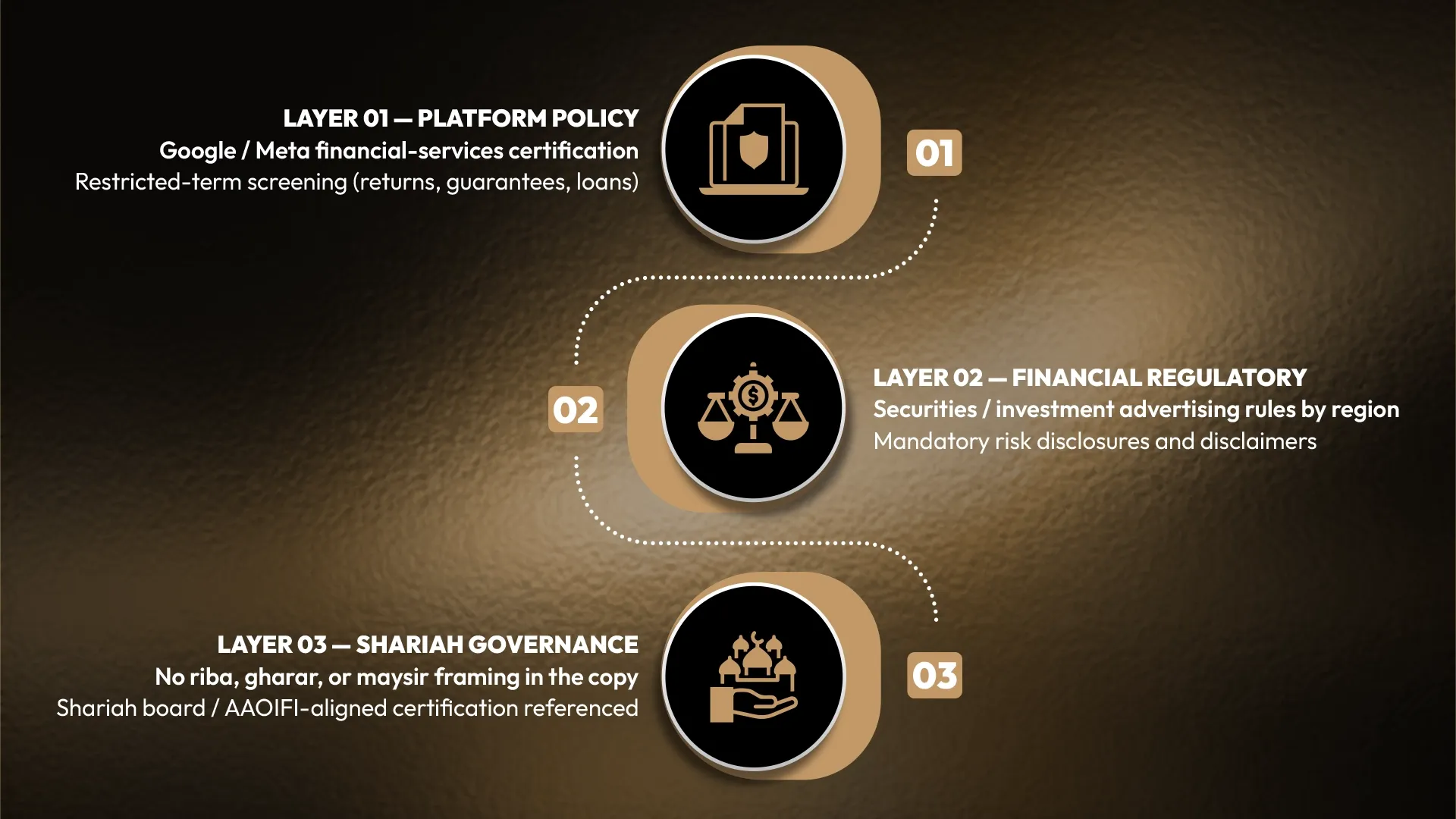
Most teams assume a single sign-off - usually legal, or a Shariah board reviewing the product itself - covers advertising too. It doesn't. Three separate layers apply to any ad for a Shariah-based investment platform, and each one is checking for something different.
Shariah-compliant product
The fund structure, asset backing, and profit distribution are reviewed and certified by a Shariah board.
Shariah-compliant advertising
Every claim, comparison, and guarantee made about that product is reviewed separately for the same standards.
The words that get Islamic investment ads rejected
Most compliance failures aren't structural - they're phrasing. The same underlying product can be described in a way that passes review or a way that doesn't, depending on the words used:
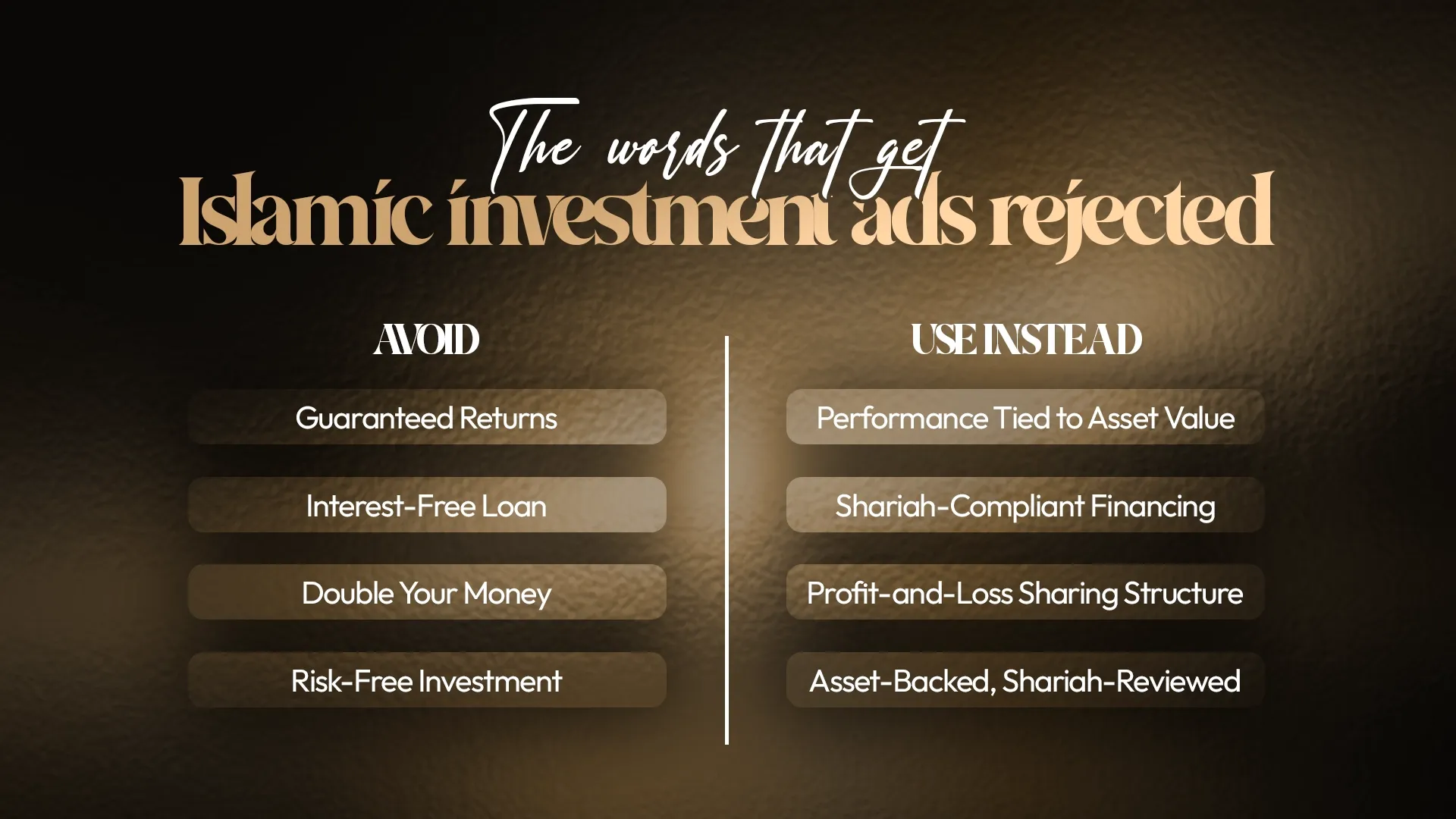
The pattern behind all four: anything implying a fixed, interest-like return (riba), anything vague enough to overstate certainty (gharar), and anything framed like a bet rather than an investment (maysir) is a rejection risk - on the ad platform, with the regulator, or with the Shariah board, and often with all three.
How the review process should work
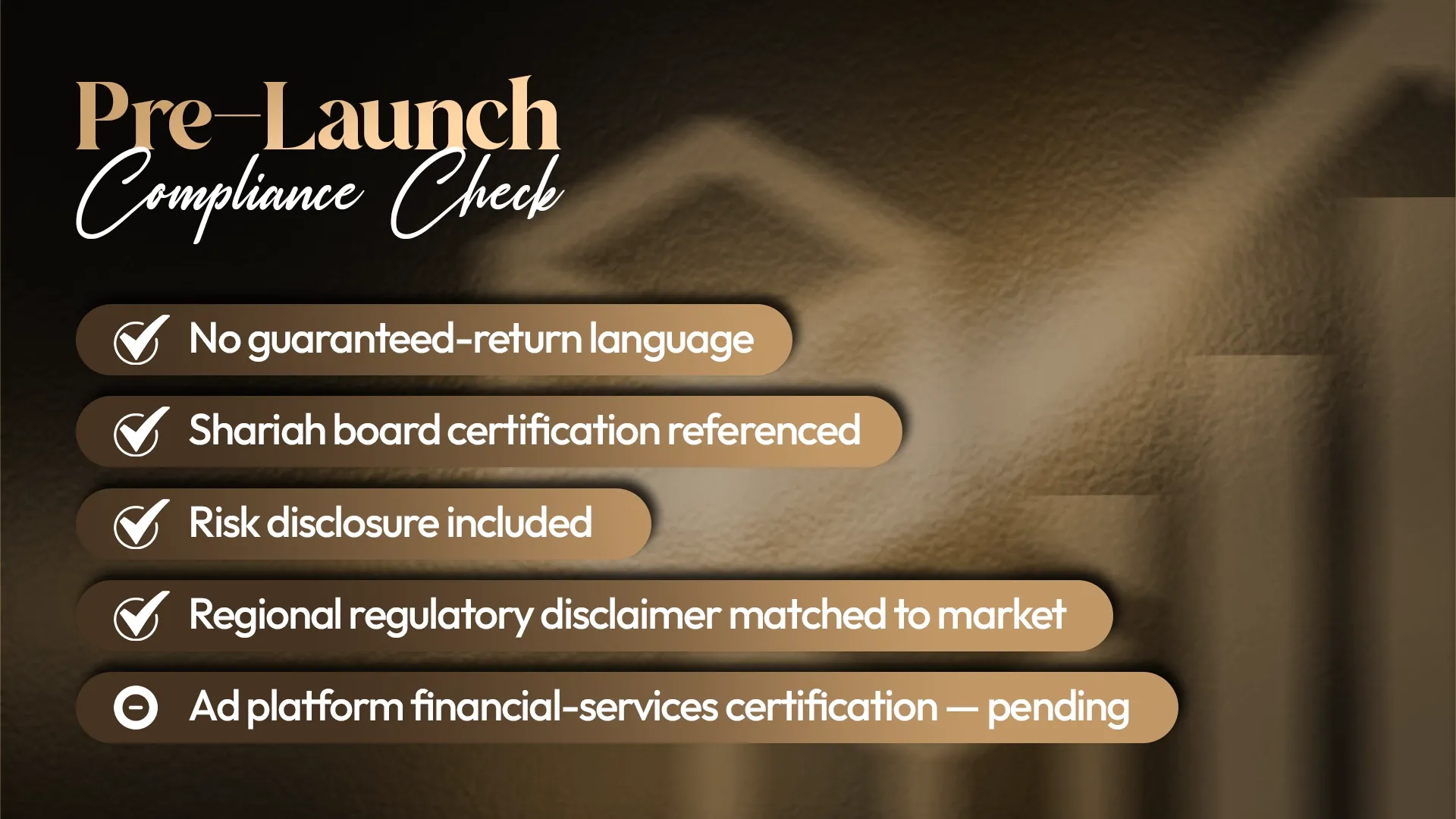
The teams that avoid rejections and rework build the check into the workflow instead of running it at the end. A working sequence looks like this: draft the creative, run it past a compliance officer against the target market's securities-advertising rules, get Shariah board or compliance sign-off on the language specifically (not just the product), then submit for the ad platform's own financial-services certification. Skipping straight to platform submission is the most common mistake - Google or Meta approving an ad says nothing about whether a regulator or a Shariah board would.
Cross-border complexity: one ad, multiple regulators
A platform advertising in more than one region can't treat a single creative as globally approved. The same headline claiming Shariah compliance may need a different risk disclaimer in each market, and a phrase that clears one regulator's advertising rules may not clear another's. The practical fix isn't writing one ad per market from scratch - it's building a compliant base version of the copy, then running region-specific disclaimer and disclosure checks on top of it before each market's launch.
What happens when compliance is skipped
The immediate cost is usually just a rejected ad - an inconvenience, not a crisis. The larger cost shows up with repeat violations or a claim that actually reaches investors: ad accounts can be suspended, regulators can issue warnings or penalties for misleading investment advertising, and in a category where trust is most of what's being sold, a single "guaranteed return" claim that turns out not to be guaranteed does more damage than the ad itself was ever worth.
Frequently asked questions
What makes financial advertising Shariah-compliant?
Can Shariah-compliant investment platforms advertise on Google and Meta?
What is gharar, and why does it matter in ad copy?
Does a Shariah-compliant investment ad need to mention AAOIFI certification?
What happens if an ad violates Shariah or regulatory advertising compliance?
The bottom line
A Shariah-compliant product doesn't automatically produce Shariah-compliant advertising - the messaging needs its own review, against its own set of rules, every time. Building that review into the workflow before submission, rather than treating an ad platform's approval as the finish line, is what keeps a compliant product from being undone by a single line of copy.
Build secure, scalable infrastructure.
The strategies and systems detailed in this briefing are built by our operations and technology desks. Reach out to explore how we deploy these solutions.
Contact Our DeskMore Blogs
How AI Automates Investor Research and Reporting in Fintech
From raw filings to a live investor dashboard - where artificial intelligence actually removes manual work from the pipeline, and where human oversight still has to stay.
What Is Investor Relations in a Cross-Border Fintech Network?
Onboarding, communication, reporting, and support - kept consistent for the same investor no matter which region, regulator, or currency is involved.