
How AI Automates Investor Research and Reporting in Fintech
From raw filings to a live investor dashboard - where artificial intelligence actually removes manual work from the pipeline, and where human oversight still has to stay.

AI automates investor research and reporting in fintech across two distinct layers. On the research side, it ingests and cross-references filings, market data, and news at a scale no analyst team can match. On the reporting side, it turns that live data into formatted, compliant reports without manual assembly. It isn't a replacement for financial judgment - it's a faster, more consistent pipeline that frees analysts to spend their time on decisions instead of data entry.
What "AI-automated investor research" actually means
Investor research has always had two parts: finding the relevant information, and deciding what it means. For decades, fintech and asset management teams have thrown people at the first part - analysts reading filings, scanning news, and building spreadsheets by hand - so they'd have time left for the second part.
AI-automated research inverts that ratio. Machine learning models handle the finding - reading documents, pulling out figures, checking them against other sources, and flagging what looks unusual - so the people on the desk spend most of their time on judgment calls instead of document review.
The manual research bottleneck AI is built to remove
The case for automation isn't about analysts being slow. It's that the volume of information a modern investment platform has to track has outgrown what manual review can keep up with:
- Volume across markets: Filings, disclosures, pricing data, and news arrive continuously and in different formats depending on the jurisdiction.
- Cross-border time lag: A platform operating across multiple regions can't wait for one time zone's business hours to process information relevant to another.
- Inconsistent formats: A PDF filing, a structured data feed, and a news wire all carry the same kind of signal in three completely different shapes.
- Delayed anomaly detection: When research is manual, something unusual in a filing is only caught once someone happens to read that specific document.
How AI automates the research layer

01. Data ingestion and normalization
Before anything can be analyzed, it has to be readable in one consistent structure. Natural language processing models extract the relevant fields from filings, statements, and news - regardless of source format - and normalize them into structured data the rest of the pipeline can work with.
02. Risk scoring and anomaly detection
Once data is structured, pattern-recognition models can compare a new filing or price movement against historical baselines and flag what's statistically unusual, long before it would surface through manual spot-checks.
03. Real-time monitoring and alerts
Instead of research happening on a schedule, models watch feeds continuously and generate alerts the moment something crosses a defined threshold - a covenant breach, a rating change, an unusual trading pattern.
04. Natural-language summarization
A large language model can condense a two-hundred-page disclosure into a short, accurate brief in the time it takes to open the document. That doesn't replace reading the source when it matters, but it changes what "reviewing" a large document set looks like day to day.
Research automation
Answers "what's happening and does it matter?" It's about finding signal in unstructured, high-volume data.
Reporting automation
Answers "how do we present this correctly?" It's about turning verified data into a compliant, readable output.
How AI automates the reporting layer
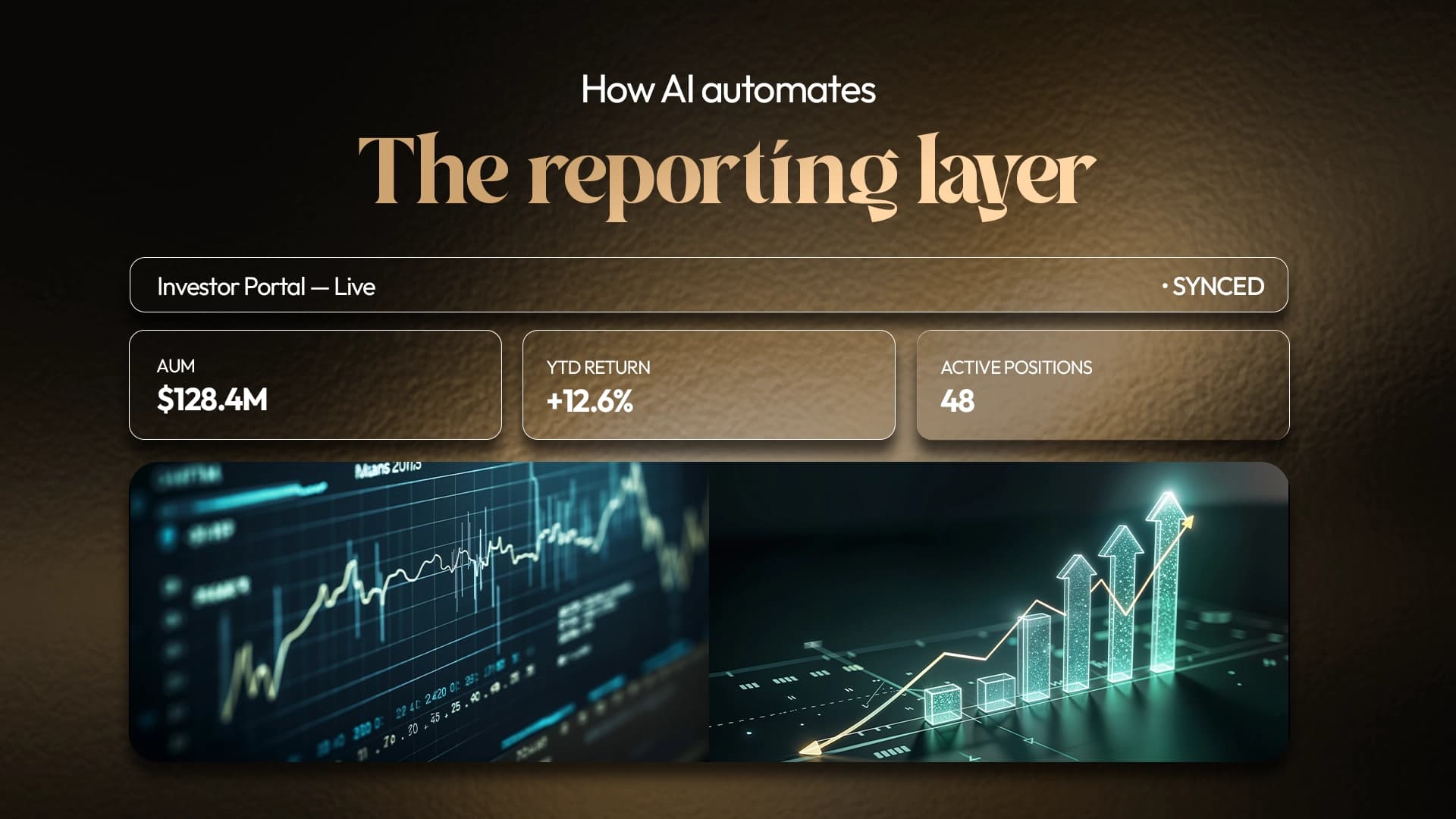
Reporting has traditionally been the most manual, least analytical part of the pipeline - pulling numbers from several systems, formatting them, writing commentary, and checking everything against a compliance template before it reaches an investor. AI changes each of those steps:
Live report generation from portfolio data
Rather than exporting figures into a document by hand, a system can generate a report directly from live ledger and portfolio data, so the numbers are always current instead of accurate as of the last manual pull.
Plain-language performance narration
Language models can draft the written commentary that usually accompanies a performance report - explaining what moved and why - as a first draft for a human to review and approve, rather than something written from scratch every reporting cycle.
Compliance-ready formatting
Reporting templates can be built to match a required structure - including AAOIFI-aligned formats for Shariah-compliant platforms - so every report is generated with the right disclosures and audit trail already in place, instead of assembled and checked manually each time.
Dashboards instead of static PDFs
A generated PDF is accurate the moment it's sent and stale the moment after. A live dashboard, backed by the same underlying data, lets an investor check current standing at any point rather than waiting for the next report cycle.
Why this matters more for cross-border, compliance-heavy platforms
The case for AI-driven research and reporting is stronger on platforms that operate across several regions and regulatory environments at once. A network running out of one time zone but serving investors and regulators in several others doesn't have the option of manual, business-hours-only monitoring - the data doesn't stop moving when one office closes. Automated ingestion and reporting keep the research and reporting layers running continuously, with every output tied back to an auditable trail rather than a person's memory of what they checked and when.

Where human oversight still has to stay in the loop
None of this makes the process fully autonomous, and platforms that market it that way are overstating what the technology does:
- Ambiguous disclosures still need a human read: Models are strong at pattern matching, not at resolving genuinely ambiguous or contradictory language in a filing.
- Compliance sign-off is a governance function: A generated report can be accurate and still require a compliance officer or Shariah board's review before it's certified.
- Model outputs need auditing, not blind trust: Any system that summarizes or drafts content needs a review step to catch errors before they reach an investor.
The realistic model isn't "AI instead of analysts." It's AI handling the first pass across everything, so analysts and compliance teams spend their time on the smaller set of things that actually need a human judgment call.
Frequently asked questions
Can AI fully replace investor research analysts?
Is AI-generated investor reporting compliant with Shariah and AAOIFI standards?
How much faster is AI-driven investor research compared to manual research?
What data sources do AI investor research tools typically use?
Is AI-based reporting secure enough for a cross-border investment platform?
The bottom line
AI doesn't remove the need for investor research or reporting expertise - it removes the manual work that used to stand between raw data and a decision. For a platform operating across multiple regions and compliance regimes, that's less about speed for its own sake and more about keeping research and reporting continuous, consistent, and auditable at a scale manual processes were never built to handle.
Build secure, scalable infrastructure.
The strategies and systems detailed in this briefing are built by our operations and technology desks. Reach out to explore how we deploy these solutions.
Contact Our DeskMore Blogs
Advertising Compliance for Shariah-Based Investment Platforms
A Shariah-compliant product can still fail an ad review. Here are the three checks - platform policy, financial regulation, and Shariah governance - every ad has to clear before it goes live.
What Is Investor Relations in a Cross-Border Fintech Network?
Onboarding, communication, reporting, and support - kept consistent for the same investor no matter which region, regulator, or currency is involved.